
Most clients who approach the Supreme Court of India are focused on one thing: winning. What they often underestimate is how much

Uncategorized
 By shivam
May 14, 2026
By shivam
May 14, 2026
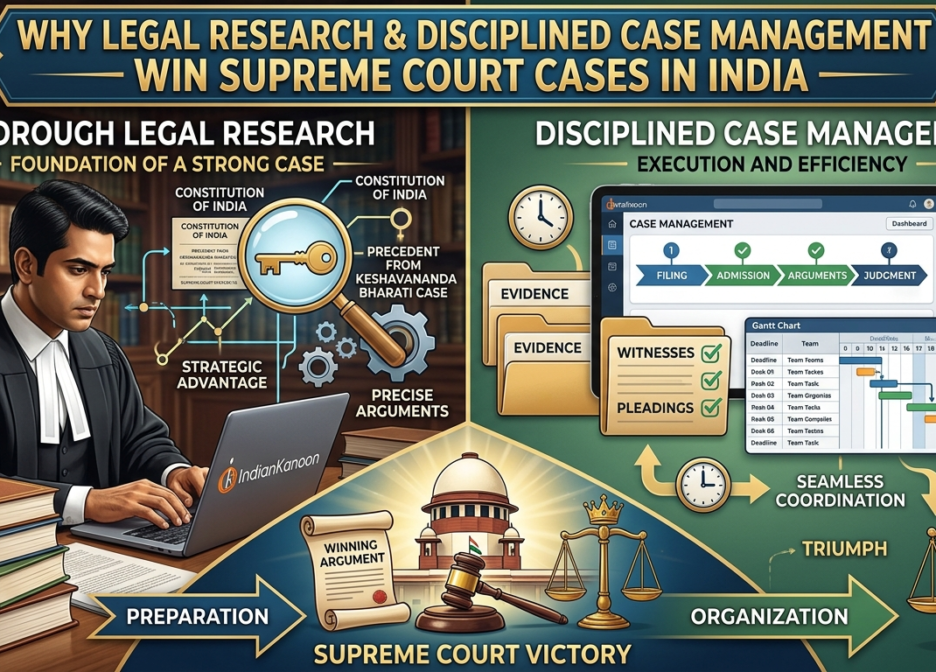
Why Legal Research & Disciplined Case Management Win Supreme Court Cases in India
By shivam
May 14, 2026
Most clients who approach the Supreme Court of India are focused on one thing: winning. What they often underestimate is how much winning depends on work that happens long before the hearing date — on the quality of legal research that identifies the best arguments, and on the rigour of case management that ensures every procedural obligation is met on time.
Advocate Shivam Sharma has built a seventeen-year Supreme Court practice on precisely these foundations. This article explains what genuine legal research and case management look like at the apex court level — and why they are not optional.
The Stakes at the Supreme Court Level
A Special Leave Petition, a Writ Petition under Article 32, a Transfer Petition, or a constitutional reference to a larger Bench — every matter before the Supreme Court arrives after the lower judiciary has already spoken. The issues that remain are typically the hardest ones: genuine questions of law, constitutional interpretation, or factual complexity that cannot be resolved without the country’s highest judicial authority.
At this level, inadequate preparation is not just unhelpful — it is actively harmful. The Supreme Court has limited patience for poorly researched arguments or procedurally deficient filings. A single misstep in framing a question of law, identifying the correct remedy, or citing the correct precedent can determine the outcome.
What Thorough Legal Research Actually Looks Like
Mapping the Statutory and Constitutional Framework
Every matter begins with an exhaustive review of the applicable statute — not just its text but its Statement of Objects and Reasons, parliamentary debates, amendment history, and the body of rules and regulations framed under it. This framework determines what arguments are available and which are foreclosed.
Comprehensive Precedent Analysis
The Supreme Court’s jurisprudence spans over seventy years and hundreds of thousands of reported decisions. Identifying the exact precedents that govern a matter — and distinguishing those that the opposing side will rely upon — requires systematic, disciplined research rather than a superficial keyword search.
Advocate Sharma’s chambers track developments across all major areas of his practice, ensuring that the most recent pronouncements of the Supreme Court and relevant High Courts are always incorporated into the legal analysis.
Identifying Conflicting High Court Views
One of the most powerful grounds for entertaining a Special Leave Petition is a conflict in the views of different High Courts on the same question of law. Identifying and documenting such conflicts is a research task that, when done well, significantly strengthens the case for the Supreme Court’s intervention.
Legislative History and Comparative Law
In constitutional matters, legislative history and comparative analysis of equivalent provisions in other common-law jurisdictions can significantly influence the Court’s interpretation. Advocate Sharma’s research practice incorporates these dimensions where they add genuine value to the argument.
A brief that cites the right precedent at the right point in the argument — rather than every precedent that is marginally relevant — reflects the kind of research discipline that the Supreme Court genuinely appreciates.
Case Management: The Procedural Backbone of Every Successful Matter
Legal research produces the arguments. Case management ensures those arguments reach the Bench in the right form, at the right time, with the right procedural posture.
Accurate Identification of the Correct Forum and Remedy
Before a matter is filed, the most fundamental case management decision is identifying the correct court and the correct remedy. A petition filed before the wrong court, or seeking a remedy that the court cannot grant, wastes time, money, and goodwill. Advocate Sharma’s experience across the Supreme Court and multiple High Courts ensures that this foundational decision is always correct.
Limitation Period Compliance
Every appellate remedy has a limitation period. Missing a limitation deadline can be fatal to a matter regardless of how strong the underlying case is. Meticulous attention to limitation is non-negotiable.
Interlocutory Application Strategy
Interim relief — whether a stay of the impugned order, an injunction, or a direction to preserve the status quo — can often be the most consequential early step in a matter. Knowing when to apply, how to frame the application, and how to argue it before the Bench requires both procedural knowledge and tactical judgment.
Filing Compliance and Defect Removal
The Supreme Court registry has detailed requirements for the compilation, pagination, indexing, and certification of all filings. Defective filings are returned, causing delay and sometimes prejudice. Advocate Sharma’s practice maintains rigorous filing standards to ensure that every submission meets registry requirements on the first attempt.
Hearing Preparation
For every hearing, a detailed brief is prepared — summarising the facts, organising the legal arguments in logical sequence, anticipating the questions the Bench is likely to ask, and identifying the specific pages in the paper-book where key documents and precedents can be found instantly.
How This Applies Across All 8 Practice Areas
The research-and-management foundation described above applies equally across every area of Advocate Sharma’s practice:
- Constitutional Law: Constitutional bench decisions, seven-judge and nine-judge bench precedents, and comparative constitutional analysis.
- Supreme Court Representation: Full preparation for every stage from admission hearing to final disposal.
- Civil Litigation: Identification of applicable limitation periods, correct framing of questions of law, and coordination of evidence.
- Criminal Law: Bail jurisprudence tracking, criminal appeal research, and sentencing precedents.
- Government & State Legal Advisory: Statutory compliance mapping and pre-decision legal risk assessment.
- High Court Representation: Court-specific procedural norms, local rules, and roster awareness.
- Policy Advisory: Policy-level legal risk analysis grounded in the latest judicial developments.
- Legal Research & Case Management: The explicit service offering that underpins everything else.
Frequently Asked Questions
How long does it take to prepare a Special Leave Petition properly?
A well-prepared SLP typically takes two to four weeks from the moment the client provides all relevant documents and the High Court judgment. Rushing this process to meet self-imposed deadlines is one of the most common causes of preventable mistakes.
What documents does Advocate Sharma need to assess a matter?
The impugned judgment or order, all relevant lower court orders, the pleadings filed before the lower court, and any statutory or contractual documents central to the dispute. An initial consultation can proceed with just the impugned judgment.
Can research and case management services be provided to another advocate’s client?
Yes. Advocate Sharma’s chambers can provide background research, precedent analysis, and brief preparation support to clients already represented by another advocate who requires specialist Supreme Court input.