
India’s Supreme Court is the final word on every legal question of significance — constitutional validity, federal

Uncategorized
 By shivam
May 14, 2026
By shivam
May 14, 2026
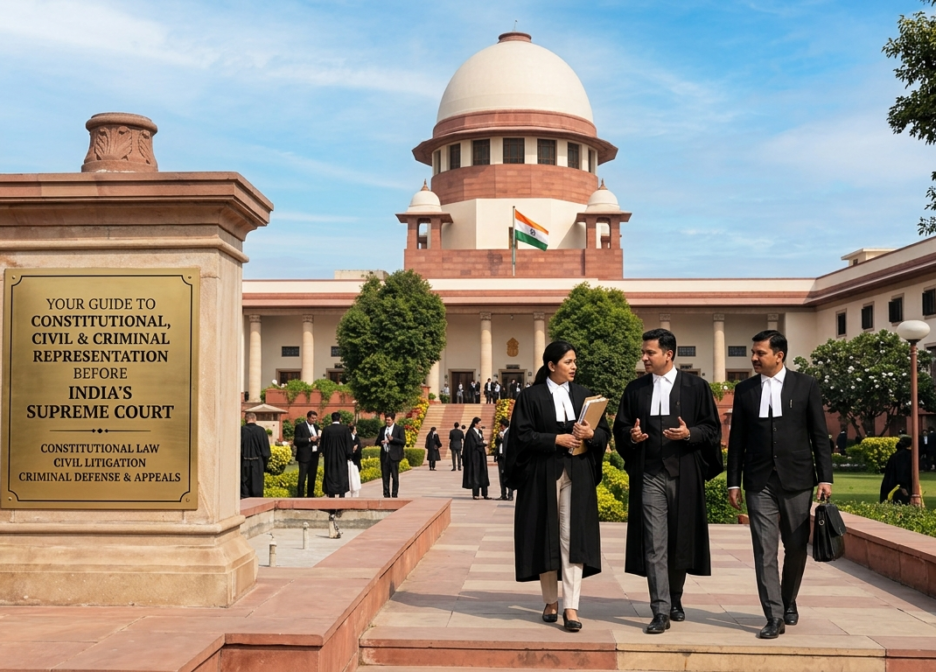
Your Guide to Constitutional, Civil & Criminal Representation Before India’s Supreme Court
By shivam
May 14, 2026
India’s Supreme Court is the final word on every legal question of significance — constitutional validity, federal disputes, fundamental rights, criminal appeals, and complex civil controversies that no lower court has been able to resolve. At that level, the quality of your counsel is the single most consequential variable in the outcome.
Advocate Shivam Sharma — Additional Advocate General and a practitioner with over seventeen years of continuous Supreme Court experience — offers dedicated, specialist representation across constitutional, civil, and criminal matters. This guide explains exactly what that means for you.
Constitutional Law Representation: Where Rights Are Decided
Constitutional law sits at the apex of India’s legal order. When a statute is challenged for violating fundamental rights, when a State government’s executive action is questioned, or when federal boundaries between the Centre and a State are disputed, the matter invariably reaches the Supreme Court under Articles 32, 131, or 136 — or a High Court under Article 226.
Advocate Sharma has represented the State of Uttarakhand and other government bodies in complex constitutional proceedings for over fifteen years. His practice in this domain covers:
- Fundamental rights petitions under Articles 19, 21, and 32
- Challenges to State and Central legislation on grounds of legislative competence
- Federal disputes between States and the Union
- Writs of mandamus, certiorari, prohibition, and quo warranto
- Constitutional validity of executive orders and administrative action
“Constitutional advocacy requires not just knowledge of the text but an instinctive feel for how the Bench has interpreted it across decades. That comes only from years of immersion in the subject.”
Supreme Court Representation: A Dedicated Appellate Practice
Not every advocate who appears in a High Court is truly comfortable before the Supreme Court. The procedural culture, the pace of hearings, the expectation of concise oral arguments, and the weight of the matters heard are qualitatively different from any other court in India.
Advocate Sharma’s entire career has been anchored at the Supreme Court. Since 2009, he has appeared continuously before the Hon’ble Court — initially as a briefing counsel and progressively as lead counsel in matters spanning a wide spectrum of civil, criminal, and constitutional proceedings. That depth of immersion produces advantages that cannot be replicated:
- Understanding of procedural timelines and urgent listing norms
- Familiarity with the Bench’s approach to specific areas of law
- Experience in framing grounds of Special Leave Petitions for maximum impact
- Ability to anticipate and respond to judicial questions from the Bench
- Network of co-counsel including several of India’s most distinguished Senior Advocates
Civil Litigation: Strategy, Research, Diligence
Civil disputes at the Supreme Court level are rarely straightforward. They typically involve questions of law that have produced conflicting High Court decisions, property and commercial disputes of significant value, service law matters with constitutional dimensions, or jurisdictional questions of national importance.
Advocate Sharma’s approach to civil litigation is built on three pillars:
Thorough Legal Research
Every brief begins with a comprehensive review of applicable statutes, the latest Supreme Court and High Court precedents, and any legislative history relevant to the dispute. Superficial research at the apex court level is a liability, not an option.
Procedural Diligence
Civil matters at the Supreme Court require meticulous attention to limitation periods, proper framing of questions of law, correct identification of the forum, and timely filing of all interlocutory applications. Every procedural step is handled with precision.
Strategic Representation
Winning at the Supreme Court often depends on how the case is framed from the very first pleading. Advocate Sharma ensures that the strongest legal arguments are identified early and consistently developed throughout the proceedings.
Criminal Law: Bail, Appeals, Revisions & Statutory Interpretation
Criminal matters before the Supreme Court carry the highest stakes — individual liberty, the integrity of criminal proceedings, and sometimes precedents that affect the entire country’s criminal justice system.
Advocate Sharma appears in criminal matters encompassing:
- Bail applications and anticipatory bail matters under Section 438 CrPC / BNSS
- Criminal appeals against High Court judgments
- Revision petitions and applications for transfer of criminal proceedings
- Statutory interpretation questions in criminal law arising from new legislation
- Matters involving the interaction of criminal law with constitutional rights
In criminal practice, the difference between a lawyer who understands the law and one who has argued it repeatedly before the Supreme Court is significant. Advocate Sharma brings both.
Why 2,000+ Cases and 500+ Clients Trust This Practice
Numbers are a proxy for consistency. Over a seventeen-year career, Advocate Sharma has accumulated a record of over 2,000 successful cases and more than 500 satisfied clients — a record built not on volume alone but on the quality of preparation and advocacy that each matter receives.
Whether the matter is a State government’s constitutional challenge, an individual’s fundamental rights petition, a complex civil dispute, or a high-stakes criminal appeal, the standard of work remains unchanged.